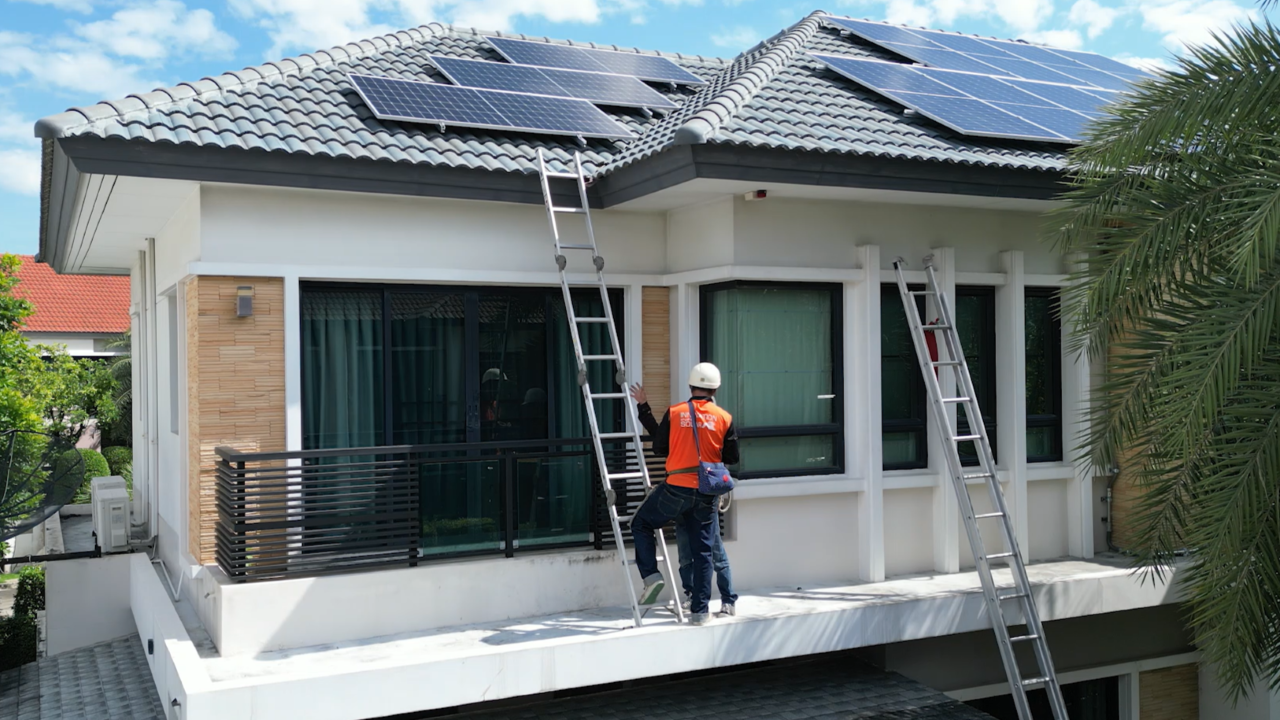
While there is no subregional mandate to deploy rooftop solar, all four BIMP-EAGA countries have policies in place to encourage its adoption. Photo credit: ADB.
Blessed with bountiful sunlight, BIMP-EAGA has significant potential to develop solar power, along with other renewables, to speed its energy transition.
With geopolitical tensions in the Middle East stoking fossil fuel prices and driving up electricity rates, households across Southeast Asia are turning to rooftop solar systems to cushion the impact on their wallets.
While there is no subregional mandate to deploy rooftop solar, all four BIMP-EAGA countries have policies in place to encourage its adoption.
Brunei Darussalam, Malaysia, and the Philippines implement a scheme, which allows consumers with rooftop solar to sell excess power generated by their system to the grid. The customers, in turn, receive electricity credits, representing savings on their power bills.
Indonesia, meanwhile, has transitioned from the net-metering scheme. It is now implementing a quota system that allows users to install their rooftop solar based on their electricity needs and the grid capacity in the location. The scheme effectively halted the grant of electricity credits under the net-metering scheme, but instead offers installation fee discounts or carbon credits. Existing rooftop solar users though can continue to offset excess power from their systems in exchange for the electricity credits.
‘Stark wake-up call’
Deploying renewable energy has become more urgent since conflicts in the Middle East escalated. According to a report from the International Energy Agency (IEA), the crisis is reinforcing the attraction of renewables, like solar, that can be developed cost-effectively at home, while aligning with longer-term transition pathways.
The conflict has provided “a stark wake-up call” for Southeast Asia’s energy system, IEA said. “The disruption in global fuel markets has exposed deep structural vulnerabilities linked to import dependence, limited diversification, and concentrated supply routes,” the agency said.
Before the crisis, around 60% of Southeast Asia’s imports of crude oil and a third of its imports of gas came from the Middle East, while 45% of its oil product supply depended on Middle Eastern crude. “The resulting price shock is already feeding through to higher energy bills, inflation, and mounting economic risk. The crisis is prompting a reassessment of policy and investment strategies amid a strong prioritization of energy security,” the report said.
IEA said energy diversification is now a central priority for Southeast Asia, with clean energy, electrification, and efficiency as key levers to reduce import exposure and strengthen resilience amid shocks like the Middle East conflict.
Since 2015, investment in renewables, electrification, and efficiency has already tempered growth in fossil fuel import requirements, saving the region around $30 billion in import costs in 2025. Renewable energy capacity stood at 120 gigawatts in 2024 and is projected to nearly triple by 2035 under existing policy settings, according to the report.
Managing electricity costs
Even households are now looking at renewable energy, specifically rooftop solar.
A Reuters report said the rush to install rooftop solar in the Philippines has resulted in the import of $407 million worth of panels from March to May, a 145% rise from the previous year. A report from energy think tank Ember said rooftop solar capacity in the country has nearly doubled to around 1,300 megawatts (MW) by early 2026 from 721 MW in early 2025.
Within BIMP-EAGA, some local governments are encouraging the use of rooftop solar.
In Cagayan de Oro City in Mindanao, the city government said it is supporting a nationwide campaign aimed at making solar power more accessible and affordable for consumers.
In May, Sarawak Minister for Utility and Telecommunication Julaihi Narawi urged households to install rooftop solar systems to better manage electricity costs while contributing to the country’s energy transition. At the time, the state received approximately 800 applications under the net-metering scheme. State utility Sarawak Energy said the applications reflect growing interest in rooftop solar among customers in the state.
In Sabah in June, the Energy Commission announced a new initiative to empower domestic consumers to generate their own electricity through rooftop solar panels. The scheme is expected to benefit up to 4,000 domestic consumers.
Globally, IEA projects the number of households relying on rooftop solar to jump to more than 100 million by 2030 from 25 million as of 2022.
To fully decarbonize the electricity sector, solar photovoltaic (PV) systems will have to be “installed everywhere possible,” starting with buildings, the report said. “Developing new PV on building rooftops, especially for households, will contribute decisively to decarbonize the electricity sector,” thanks to smart self-consumption policies, new business models for cross-cutting applications like electric mobility and solar-based heating and cooling (through heat pumps, direct heating), and emerging applications.
Energy security
BIMP-EAGA recognizes that renewable energy and energy efficiency measures are key to strengthening energy security and lowering greenhouse gas emissions.
The subregion is well-positioned to unlock green growth opportunities given its potential to harness renewable resources, which include solar, hydropower, biomass, wind, and geothermal energy.
The island of Borneo, for example, can become a clean energy powerhouse with significant solar, hydro, and wind resources located centrally to large power markets in Java and Sulawesi in Indonesia, the Philippines, and Singapore.
Under BIMP-EAGA's Vision 2035 development plan, the subregion targets 30%–61% renewable energy capacity, while seeking to achieve 100% electrification rate. It aims for the completion of 10 ongoing power and energy infrastructure projects and scale up at least three programs or projects with energy efficient-standard, technologies, and practices. Member countries also committed to support regulatory harmonization and policy enablers to advance the ASEAN Power Grid.